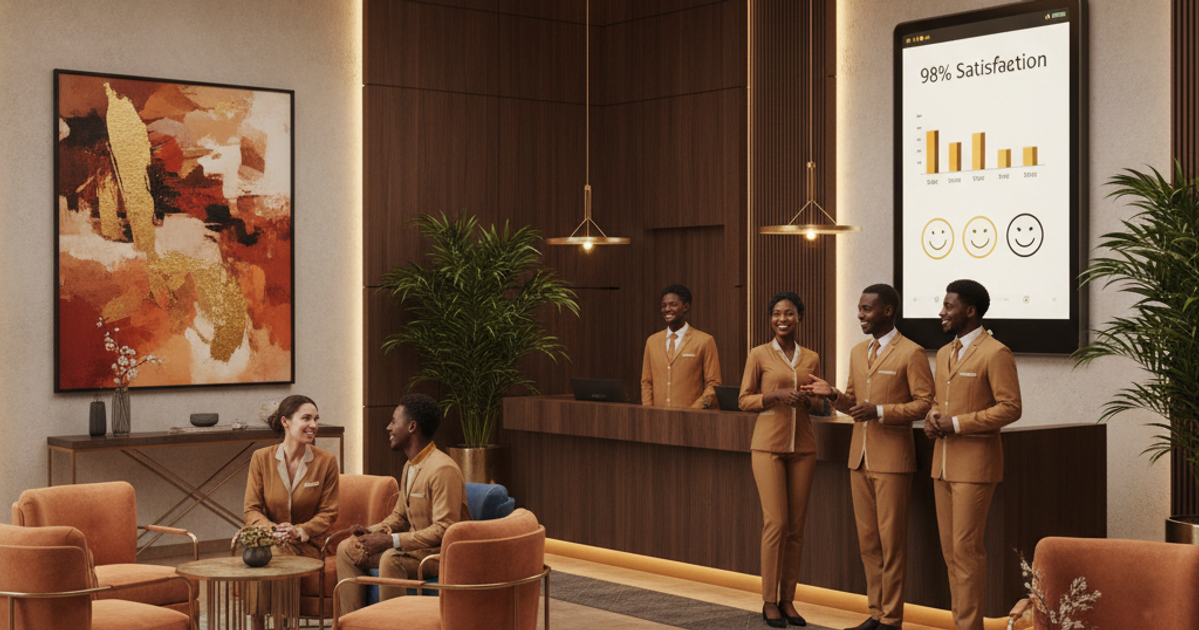
Guest satisfaction has always been the heartbeat of hospitality. But in Kenya's rapidly growing hotel industry — projected to reach $1.2 billion in revenue by 2027 — the old methods of measuring it are falling behind. Comment cards sit unread, post-stay surveys go unanswered, and by the time a manager spots a trend in complaints, dozens of guests have already left disappointed.
Artificial intelligence is changing this equation entirely. Hotels across Nairobi, Mombasa, and the Maasai Mara are now using AI to capture, analyse, and act on guest feedback in real time — turning satisfaction from a lagging indicator into a competitive advantage.
Why Traditional Guest Feedback Falls Short in African Hospitality
The typical hotel feedback loop is broken. Industry data shows that only 1 in 26 unhappy guests actually complains — the rest simply leave and never return. For Kenyan hotels competing in a market where repeat guests and word-of-mouth referrals drive up to 40% of bookings, this silent churn is devastating.
Traditional approaches suffer from three core problems:
- Low response rates: Paper surveys and generic email questionnaires see completion rates below 5% in most African markets.
- Delayed insights: By the time quarterly reports surface a recurring issue — say, slow check-in times or inconsistent room cleaning — the damage is already done.
- Language and cultural gaps: Kenya's tourism market serves guests from dozens of countries. A single-language survey misses nuance, and cultural differences in how people express dissatisfaction make interpretation unreliable.
AI-powered feedback platforms like Maoni solve these problems by analysing guest sentiment across every touchpoint — from online reviews and social media mentions to in-stay messaging and post-checkout surveys — in multiple languages and in real time.
Real-Time Sentiment Analysis: Catching Problems Before Checkout
Imagine a guest posts on TripAdvisor that the Wi-Fi at your Nairobi hotel was unreliable during their conference. With traditional monitoring, you might see that review days later. With AI sentiment analysis, the system flags negative mentions within minutes, categorises the issue, and alerts the relevant team.
This is not hypothetical. Hotels using AI-driven sentiment analysis report:
- 23% faster issue resolution — problems get fixed while the guest is still on property
- 15-20% improvement in online review scores within the first six months
- Reduction in negative reviews by up to 30% through proactive service recovery
The technology works by processing natural language — whether in English, Swahili, French, or any other language your guests use — and classifying feedback into categories like room quality, staff friendliness, food and beverage, cleanliness, and value for money. It then assigns sentiment scores and tracks trends over time.
For a hotel group operating across multiple properties in Kenya, this means a centralised dashboard showing exactly where each location excels and where it needs attention.
Predictive Guest Intelligence: Anticipating Needs Before They Arise
The most powerful application of AI in guest satisfaction goes beyond reactive analysis. Predictive models can now forecast which guests are likely to be dissatisfied based on patterns in their booking behaviour, past stays, and real-time signals.
For example, AI might identify that:
- A returning guest who previously complained about noise has been booked near the elevator — flag for room reassignment
- Business travellers arriving on late flights consistently rate their experience lower if check-in takes more than 5 minutes — pre-prepare their keys
- Guests celebrating special occasions who don't receive any acknowledgment are 3x more likely to leave a neutral (rather than positive) review
This predictive layer transforms guest satisfaction from a measurement exercise into a proactive strategy. Hotels using RevenueIQ alongside guest intelligence tools can even correlate satisfaction drivers with revenue impact — understanding exactly how much a one-point improvement in dining satisfaction affects average spend per guest.
Automating Personalised Guest Communication at Scale
Kenya's hospitality sector ranges from boutique lodges in Amboseli to large conference hotels in Nairobi's Upper Hill district. Regardless of size, personalised communication drives satisfaction — but doing it manually doesn't scale.
AI enables hotels to:
- Send personalised pre-arrival messages based on the guest's booking purpose, preferences, and history
- Trigger mid-stay check-ins at the optimal moment (AI learns when guests are most responsive)
- Craft post-stay follow-ups that reference specific aspects of the guest's experience, rather than generic thank-you emails
- Respond to online reviews with contextually appropriate replies that address specific feedback points
A lodge in the Maasai Mara, for instance, might use AI to identify that a guest mentioned interest in birdwatching during their booking. The system automatically suggests relevant activities to the guest relations team, creating a personalised itinerary that drives satisfaction and positive reviews.
Building a Data-Driven Satisfaction Culture
Technology alone doesn't improve guest satisfaction — people do. But AI gives hotel teams the data and insights they need to make better decisions daily.
Practical steps for Kenyan hotels looking to implement AI-driven guest satisfaction:
- Start with what you have: Consolidate existing feedback from OTAs, Google Reviews, social media, and internal surveys into a single AI-powered platform.
- Set clear KPIs: Track Net Promoter Score (NPS), Guest Satisfaction Index (GSI), and sentiment trends by category — not just overall ratings.
- Empower frontline staff: Share AI insights with reception, housekeeping, and F&B teams through simple dashboards and real-time alerts.
- Close the loop: Ensure every piece of negative feedback triggers a defined service recovery workflow.
- Measure ROI: Connect satisfaction improvements to revenue metrics — repeat booking rates, average daily rate acceptance, and ancillary spend.
Hotels that treat guest satisfaction as a data discipline rather than an afterthought consistently outperform their competitors. In Kenya's increasingly competitive market — with new properties opening regularly and platforms like Airbnb capturing the budget segment — this edge matters more than ever.
The Future of Guest Satisfaction in African Hospitality
The trajectory is clear. As AI tools become more accessible and affordable, even mid-size Kenyan hotels will be able to leverage the same guest intelligence capabilities that global chains have used for years. The democratisation of this technology is particularly significant for Africa, where hospitality is one of the fastest-growing economic sectors.
Emerging capabilities include:
- Voice sentiment analysis for phone interactions and in-person conversations
- Visual AI that can assess room readiness and presentation quality
- Predictive staffing models that align service capacity with expected demand and guest profiles
- Integrated revenue and satisfaction optimisation that finds the sweet spot between pricing and guest experience
The hotels that invest in these capabilities now will define the standard for African hospitality in the next decade.
Ready to transform how your hotel understands and improves guest satisfaction? Book a demo to see how Edrene's AI-powered tools can give you real-time insights into what your guests really think — and what to do about it.
Ready to transform your business?
See how Edrene Technologies can help you make smarter decisions with AI.
Request Demo