How Customer Feedback AI Is Transforming Hospitality in Africa
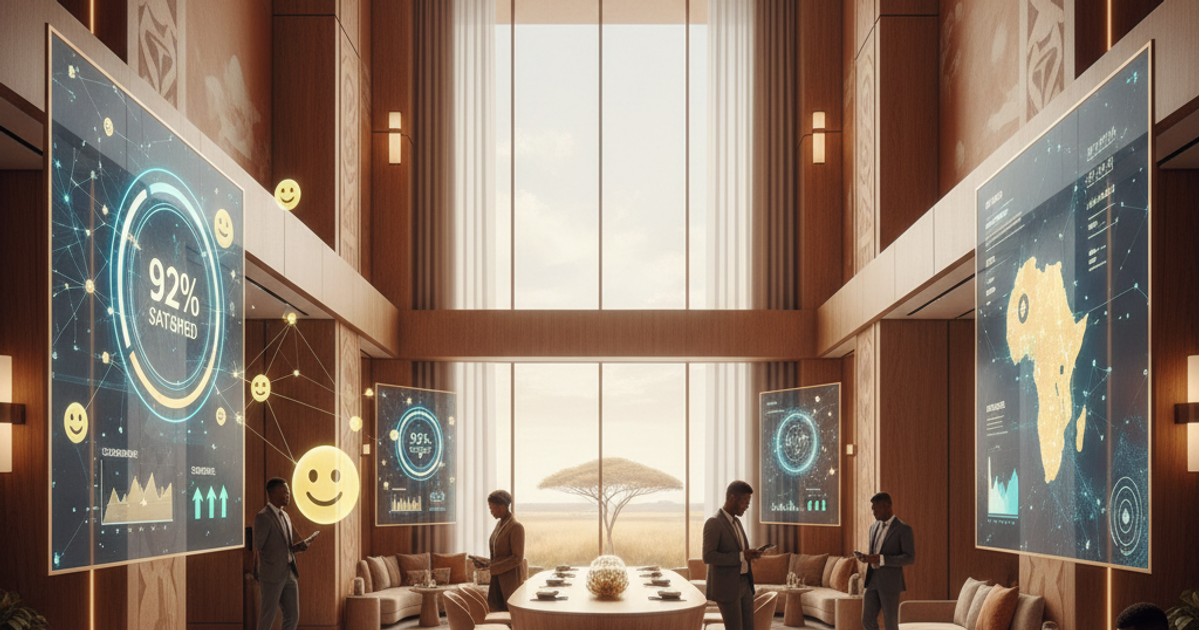
Every hotel guest has a story to tell. The question is: are you listening?
Across Africa's booming hospitality sector, hotels generate thousands of guest reviews, survey responses, and social media mentions every month. Yet most properties still rely on manual review reading — or worse, ignore feedback entirely. The result? Missed opportunities, recurring complaints, and guests who quietly leave for the competition.
Customer feedback AI in hospitality changes the equation. By applying artificial intelligence to guest sentiment data, hotels can identify patterns, predict dissatisfaction, and act before problems escalate. For African hospitality businesses competing in an increasingly digital market, this isn't a luxury — it's a necessity.
Why Traditional Feedback Methods Fall Short in African Hotels
Most hotels in Kenya, Nigeria, South Africa, and across the continent still manage guest feedback through a patchwork of systems: paper comment cards, post-stay email surveys, and occasional TripAdvisor checks. The problems with this approach are well-documented:
- Low response rates: Paper surveys see 5–15% completion. Email surveys fare slightly better at 20–30%, but that still means the majority of guests leave without sharing their experience.
- Delayed action: By the time a manager reads a negative review, the guest is already gone — and may have told 10 friends.
- Volume overwhelm: A 200-room hotel generating 70% occupancy sees roughly 4,200 stays per month. Even if 20% leave feedback, that's 840 data points no human team can systematically analyse.
- Language barriers: Guests leave feedback in English, Swahili, French, Arabic, and dozens of other languages. Manual translation is slow and expensive.
The gap between the data hotels have and the insights they use is where revenue leaks. A 2024 study by Deloitte found that hotels responding to feedback within 24 hours see a 12% increase in repeat bookings — but fewer than 18% of African hotels meet that benchmark.
How AI-Powered Sentiment Analysis Works for Hotels
Customer feedback AI uses natural language processing (NLP) and machine learning to do what humans cannot: process every piece of feedback, in any language, in real time.
Here's what the technology actually does:
Automated Review Aggregation
AI platforms pull reviews from Google, TripAdvisor, Booking.com, social media, in-app surveys, and direct emails into a single dashboard. No more switching between six tabs to understand your reputation.
Sentiment Scoring and Categorisation
Each review is broken down by topic — cleanliness, staff friendliness, food quality, Wi-Fi, check-in speed — and assigned a sentiment score. Instead of reading 200 reviews, a general manager sees: "Cleanliness sentiment dropped 14% this month, driven by complaints about Room Block C."
Trend Detection and Predictive Alerts
AI doesn't just report what happened — it spots what's about to happen. If breakfast complaints tick upward three weeks in a row, the system flags it before it hits your TripAdvisor rating.
Multilingual Processing
Modern NLP models handle Swahili, Amharic, French, Arabic, and Afrikaans with increasing accuracy. A guest leaving a review in Sheng (Kenyan slang) is no longer invisible to management.
Tools like Maoni by Edrene Technologies are purpose-built for this use case, offering hospitality-specific sentiment analysis tailored to African markets.
Real-World Impact: What the Numbers Say
The business case for customer feedback AI in hospitality is compelling:
- Revenue uplift: Hotels using AI-driven feedback loops report 8–15% increases in RevPAR (Revenue Per Available Room) within the first year, according to a 2025 Cornell Hospitality Report.
- Staff efficiency: Automated feedback triage reduces front-desk complaint handling time by 40%, freeing staff to focus on guest experience.
- Review scores: Properties that systematically respond to AI-prioritised feedback see an average 0.3–0.5 point increase in their Google rating within six months.
- Guest retention: Identifying and resolving issues for at-risk guests before checkout increases the likelihood of a return visit by 23%.
Consider a mid-range hotel in Nairobi running 150 rooms. If AI-driven feedback improvements increase their average Google rating from 4.1 to 4.4, research suggests this alone could drive a 9% increase in direct bookings — worth approximately KES 8–12 million annually.
Five Practical Steps to Implement Feedback AI at Your Property
You don't need a massive budget or a dedicated data team to get started. Here's a practical roadmap:
1. Centralise Your Feedback Channels
Before AI can help, it needs data. Audit every place guests leave feedback: OTA reviews, Google, social media, WhatsApp messages, front-desk logs. Most hotels discover 3–5 channels they weren't monitoring.
2. Choose a Platform Built for Hospitality
Generic sentiment analysis tools miss hospitality-specific context. "The room was cool" means something very different in a hotel review than in casual conversation. Look for platforms that understand hospitality vocabulary and African market nuances. Maoni was designed specifically for this purpose.
3. Set Up Real-Time Alerts
Configure your AI tool to flag urgent issues immediately — mentions of safety, health, or billing disputes should trigger instant notifications to duty managers. Non-urgent trends (Wi-Fi complaints trending up) can be reviewed weekly.
4. Close the Loop with Guests
AI identifies the problem; your team fixes it. The most impactful hotels create a "feedback response SLA": negative reviews get a personal response within 4 hours, and the guest is contacted directly when possible. This turns detractors into advocates.
5. Connect Feedback to Revenue Decisions
The real power emerges when you link guest sentiment data to your revenue management strategy. If AI tells you that guests paying premium rates consistently complain about breakfast quality, that's a pricing-experience mismatch you can fix before it erodes your rate integrity.
The African Hospitality Opportunity
Africa's travel and tourism sector is projected to contribute $168 billion to the continent's GDP by 2028 (World Travel & Tourism Council). With international arrivals growing at 5.8% annually — faster than the global average — the hotels that win will be those that listen better, respond faster, and improve continuously.
Customer feedback AI levels the playing field. A 50-room boutique lodge in the Maasai Mara can now access the same calibre of guest intelligence that global chains spend millions developing in-house. The technology is accessible, the ROI is proven, and the competitive advantage goes to early movers.
The question isn't whether African hotels need customer feedback AI. It's whether they can afford to wait.
Ready to Turn Guest Feedback Into Your Competitive Edge?
Edrene Technologies helps African hospitality businesses harness AI to understand their guests better, respond faster, and grow smarter. Whether you're managing a single property or a portfolio across multiple countries, our tools are built for your market.
Book a demo today and see how Maoni and RevenueIQ can transform your guest feedback into measurable business results.
Ready to transform your business?
See how Edrene Technologies can help you make smarter decisions with AI.
Request Demo